

-
5 Entradas
-
4 Fotos
-
0 Videos
-
Male
-
seguida por 2 people
Buscar





 English
 Arabic
 French
 Portuguese
 Deutsch
 Turkish
 Dutch
Dutch
 Italiano
 Russian
 Romaian
 Portuguese (Brazil)
 Greek
Greek
Actualizaciones Recientes
-
The Union Cabinet of India approved a support package of around ₹45,000 crore aimed at bolstering exports and helping the MSME (Micro, Small & Medium Enterprises) sector amid rising global trade headwinds.
This comes in the context of the United States having imposed steep tariffs (up to ~50%) on several Indian export items — textiles, jewellery, leather goods, chemicals — which has put significant pressure on labour-intensive sectors.
The package is split broadly into two parts:
An outlay of about ₹25,060 crore for the “Export Promotion Mission (EPM)” over a period of six years (starting FY26) aimed at strengthening India’s export ecosystem.
Around ₹20,000 crore for a Credit Guarantee Scheme for Exporters (CGSE) — providing collateral-free credit guarantees and additional working capital support for exporters.
The EPM will consolidate previous fragmented export-support schemes (such as Interest Equalisation, Market Access) into a more coherent framework, with two key pillars:
“Niryat Protsahan” (trade-finance support for MSMEs)
“Niryat Disha” (non-financial support: branding, logistics, compliance, export warehousing, etc.)
Priority sectors for support: textiles, leather, gems & jewellery, engineering goods, marine products — especially those impacted by tariffs and global demand headwinds.
Why it matters
For India’s export-oriented MSMEs, the timing is crucial: these firms are under pressure from higher input costs, global slowdown, tariff barriers and supply-chain disruptions. Such a package aims to ease liquidity, reduce cost burden and help explore new markets.
By consolidating export-support under the EPM, the government intends to streamline subsidies/supports, reduce duplication and deliver targeted support based on outcome rather than just input.
Boosting exports is important for India’s economic growth, employment (especially in labour-intensive sectors) and external sector balance. A strong export package sends a signal of policy support.
The non-financial support component (branding, warehousing, logistics) recognises that competitiveness is not just about subsidies, but about capability, compliance and market access.
Things to watch / caveats
Even though the headline commitment is large (~₹45,000 crore), effective disbursement, timely implementation and clarity of guidelines will be critical. Some analysts have flagged that moving from policy announcement to execution may take time. For example, a think-tank noted that the EPM still lacks detailed schemes and processes.
The global environment remains challenging: tariff risks (especially from the US), geopolitical supply-chain stresses, and competition from other low-cost countries. The package is helpful, but it does not eliminate these risks.
There will be a need to ensure that the support reaches smaller exporters (MSMEs) and not just large firms. Also, monitoring the impact and avoiding misuse will be important.
The focus on priority sectors is helpful, but diversification into newer markets (beyond traditional ones) will be essential to offset tariff risk and global demand weakness.The Union Cabinet of India approved a support package of around ₹45,000 crore aimed at bolstering exports and helping the MSME (Micro, Small & Medium Enterprises) sector amid rising global trade headwinds. This comes in the context of the United States having imposed steep tariffs (up to ~50%) on several Indian export items — textiles, jewellery, leather goods, chemicals — which has put significant pressure on labour-intensive sectors. The package is split broadly into two parts: An outlay of about ₹25,060 crore for the “Export Promotion Mission (EPM)” over a period of six years (starting FY26) aimed at strengthening India’s export ecosystem. Around ₹20,000 crore for a Credit Guarantee Scheme for Exporters (CGSE) — providing collateral-free credit guarantees and additional working capital support for exporters. The EPM will consolidate previous fragmented export-support schemes (such as Interest Equalisation, Market Access) into a more coherent framework, with two key pillars: “Niryat Protsahan” (trade-finance support for MSMEs) “Niryat Disha” (non-financial support: branding, logistics, compliance, export warehousing, etc.) Priority sectors for support: textiles, leather, gems & jewellery, engineering goods, marine products — especially those impacted by tariffs and global demand headwinds. 📌 Why it matters For India’s export-oriented MSMEs, the timing is crucial: these firms are under pressure from higher input costs, global slowdown, tariff barriers and supply-chain disruptions. Such a package aims to ease liquidity, reduce cost burden and help explore new markets. By consolidating export-support under the EPM, the government intends to streamline subsidies/supports, reduce duplication and deliver targeted support based on outcome rather than just input. Boosting exports is important for India’s economic growth, employment (especially in labour-intensive sectors) and external sector balance. A strong export package sends a signal of policy support. The non-financial support component (branding, warehousing, logistics) recognises that competitiveness is not just about subsidies, but about capability, compliance and market access. ⚠️ Things to watch / caveats Even though the headline commitment is large (~₹45,000 crore), effective disbursement, timely implementation and clarity of guidelines will be critical. Some analysts have flagged that moving from policy announcement to execution may take time. For example, a think-tank noted that the EPM still lacks detailed schemes and processes. The global environment remains challenging: tariff risks (especially from the US), geopolitical supply-chain stresses, and competition from other low-cost countries. The package is helpful, but it does not eliminate these risks. There will be a need to ensure that the support reaches smaller exporters (MSMEs) and not just large firms. Also, monitoring the impact and avoiding misuse will be important. The focus on priority sectors is helpful, but diversification into newer markets (beyond traditional ones) will be essential to offset tariff risk and global demand weakness.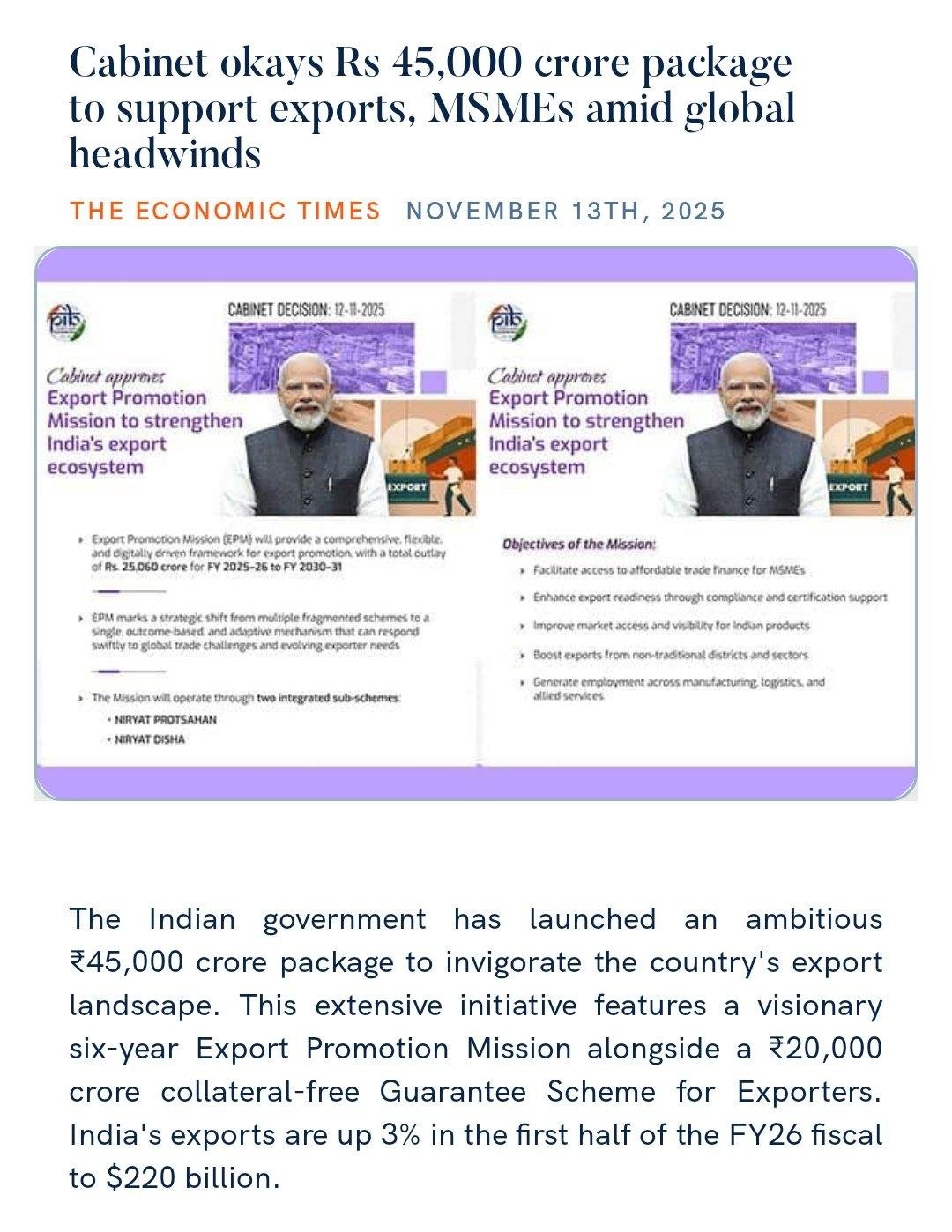 0 Commentarios 0 Acciones 2K Views 0 Vista previa
 -
The combined capital expenditure by CPSEs and other central agencies (including Indian Railways and National Highways Authority of India) rose by 13% year-on-year in April–October 2025–26.
In this April–October period, the total capex was about ₹4.4 lakh crore, compared with about ₹3.9 lakh crore in the same period last year.
This spending accounts for 56.5% of the full-year target of ~₹7.85 lakh crore.
However, the pace of investment slowed in October: capex growth in October alone was ~6% year-on-year, with spending of ~₹58,327 crore.
Major drivers: Railways + NHAI account for ~₹4.4 lakh crore — about 56% of the total FY26 target for CPSEs & central agencies.
For FY25: These entities invested ₹7.86 lakh crore) by ~3%.
Interpretation / significance
A 13% year-on-year growth in capex suggests continuing momentum in government-led investment.
Achieving over half the full-year target within the first seven months is a positive indicator for meeting or exceeding FY26 targets.
The slowdown in October (growth only ~6%) might signal some caution: high base effects (for example, a strong September), or project execution bottlenecks.
Heavy dependence on rail & highways means any delay or slowdown in those sectors could impact overall capex execution.
Given that public investment is a key driver of growth in India, strong capex performance is supportive of broader economic momentum.
Caveats / things to watch
While the growth looks decent, the base was moderately high last year, so sustaining higher growth may be challenging.
Execution risks: large-scale spend needs timely clearances, land acquisition, supply chain etc. Any delays could slow down capex.
Sectoral concentration: With so much of the capex concentrated in rail & highways, the risk is less diversification — if those segments slow, the aggregate may suffer.
The article notes moderation in October — important to monitor whether that trend continues into the remaining months of the fiscal.
The combined capital expenditure by CPSEs and other central agencies (including Indian Railways and National Highways Authority of India) rose by 13% year-on-year in April–October 2025–26. In this April–October period, the total capex was about ₹4.4 lakh crore, compared with about ₹3.9 lakh crore in the same period last year. This spending accounts for 56.5% of the full-year target of ~₹7.85 lakh crore. However, the pace of investment slowed in October: capex growth in October alone was ~6% year-on-year, with spending of ~₹58,327 crore. Major drivers: Railways + NHAI account for ~₹4.4 lakh crore — about 56% of the total FY26 target for CPSEs & central agencies. For FY25: These entities invested ₹7.86 lakh crore) by ~3%. Interpretation / significance A 13% year-on-year growth in capex suggests continuing momentum in government-led investment. Achieving over half the full-year target within the first seven months is a positive indicator for meeting or exceeding FY26 targets. The slowdown in October (growth only ~6%) might signal some caution: high base effects (for example, a strong September), or project execution bottlenecks. Heavy dependence on rail & highways means any delay or slowdown in those sectors could impact overall capex execution. Given that public investment is a key driver of growth in India, strong capex performance is supportive of broader economic momentum. Caveats / things to watch While the growth looks decent, the base was moderately high last year, so sustaining higher growth may be challenging. Execution risks: large-scale spend needs timely clearances, land acquisition, supply chain etc. Any delays could slow down capex. Sectoral concentration: With so much of the capex concentrated in rail & highways, the risk is less diversification — if those segments slow, the aggregate may suffer. The article notes moderation in October — important to monitor whether that trend continues into the remaining months of the fiscal. 0 Commentarios 0 Acciones 2K Views 0 Vista previa
 -
During April-September 2025, India’s textile exports to 111 countries grew from about US$7.7 billion to US$8.5 billion — about a 10% increase.
Meanwhile exports to the US fell by 2.6%, down to about US$5.2 billion, as the US imposed 63.9% duties on Indian apparel from 27 August 2025.
In particular, supplies to 38 countries increased by more than 50% year-on-year; exports to a further 16 countries rose by 25-50%; and to 57 countries the growth was under 25%.
The Indian government is pushing diversification of export markets (beyond the US) by focusing on free trade agreement (FTA) partner nations and other high-potential destinations, including efforts through export promotion councils and Indian missions abroad.
India has a target of raising textile exports to US$100 billion by 2030, up from the current ~US$37.7 billion.During April-September 2025, India’s textile exports to 111 countries grew from about US$7.7 billion to US$8.5 billion — about a 10% increase. Meanwhile exports to the US fell by 2.6%, down to about US$5.2 billion, as the US imposed 63.9% duties on Indian apparel from 27 August 2025. In particular, supplies to 38 countries increased by more than 50% year-on-year; exports to a further 16 countries rose by 25-50%; and to 57 countries the growth was under 25%. The Indian government is pushing diversification of export markets (beyond the US) by focusing on free trade agreement (FTA) partner nations and other high-potential destinations, including efforts through export promotion councils and Indian missions abroad. India has a target of raising textile exports to US$100 billion by 2030, up from the current ~US$37.7 billion.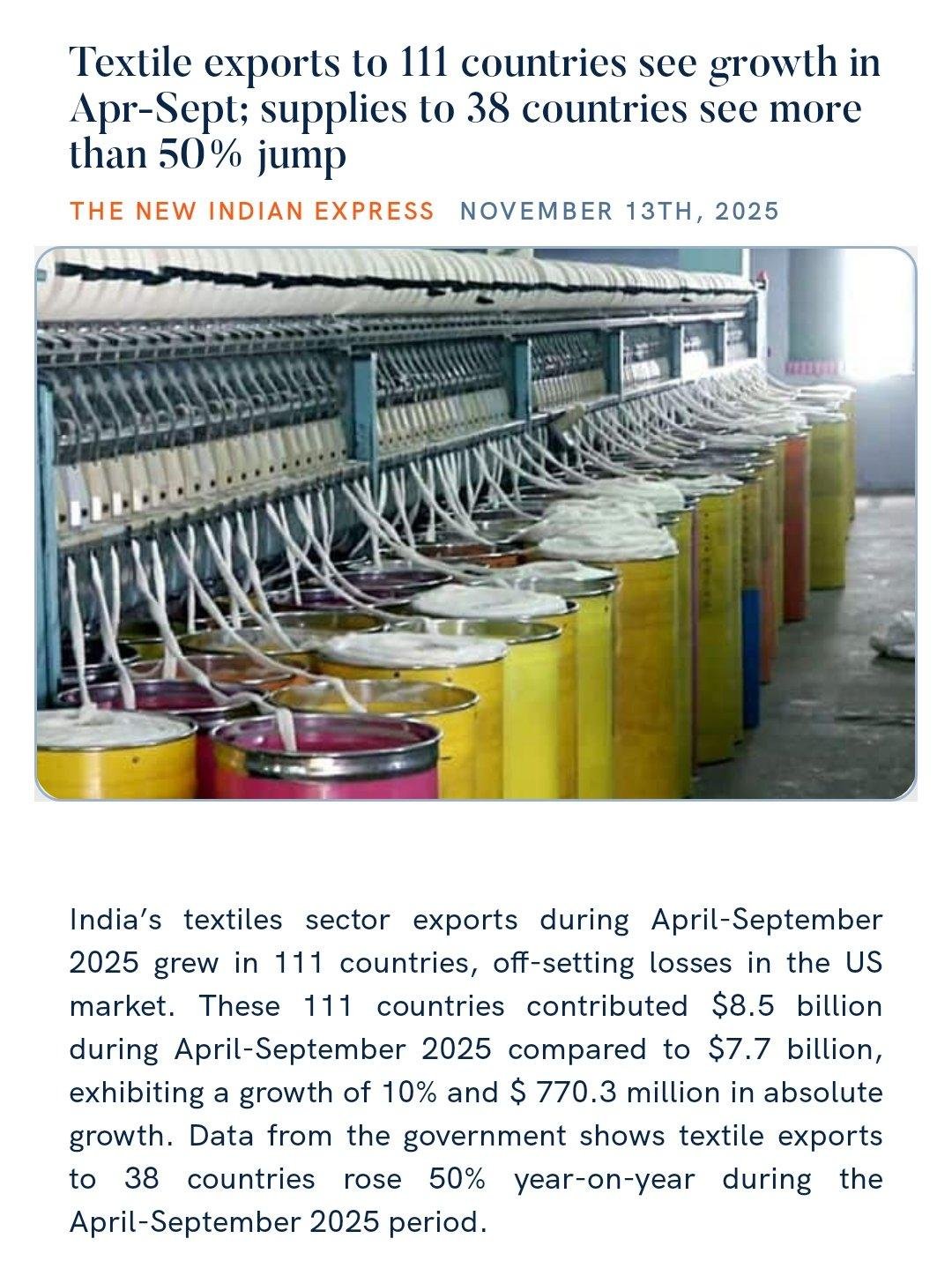 0 Commentarios 0 Acciones 2K Views 0 Vista previa
 -
Welcome to the World’s First Responsible Social Media Platform
If you are not a responsible social media user, this is not the place for you.
Here, we believe that our words, ideas, and actions online carry real-world impact.
This platform is built for those who want to engage, not enrage — to discuss, not divide.
Let’s move beyond politics and start engaging on policies — thoughtfully, respectfully, and responsibly.
From India to the world, we are setting a new standard for digital citizenship.
Let’s build a space where integrity, empathy, and accountability define every interaction.
Welcome to the future of social media — Responsible. Real. Revolutionary.
#ResponsibleSocialMedia #FromIndiaToTheWorld #PolicyOverPolitics #DigitalResponsibilityWelcome to the World’s First Responsible Social Media Platform If you are not a responsible social media user, this is not the place for you. Here, we believe that our words, ideas, and actions online carry real-world impact. This platform is built for those who want to engage, not enrage — to discuss, not divide. Let’s move beyond politics and start engaging on policies — thoughtfully, respectfully, and responsibly. From India to the world, we are setting a new standard for digital citizenship. Let’s build a space where integrity, empathy, and accountability define every interaction. Welcome to the future of social media — Responsible. Real. Revolutionary. #ResponsibleSocialMedia #FromIndiaToTheWorld #PolicyOverPolitics #DigitalResponsibility0 Commentarios 0 Acciones 2K Views 0 Vista previa


Quizás te interese…