
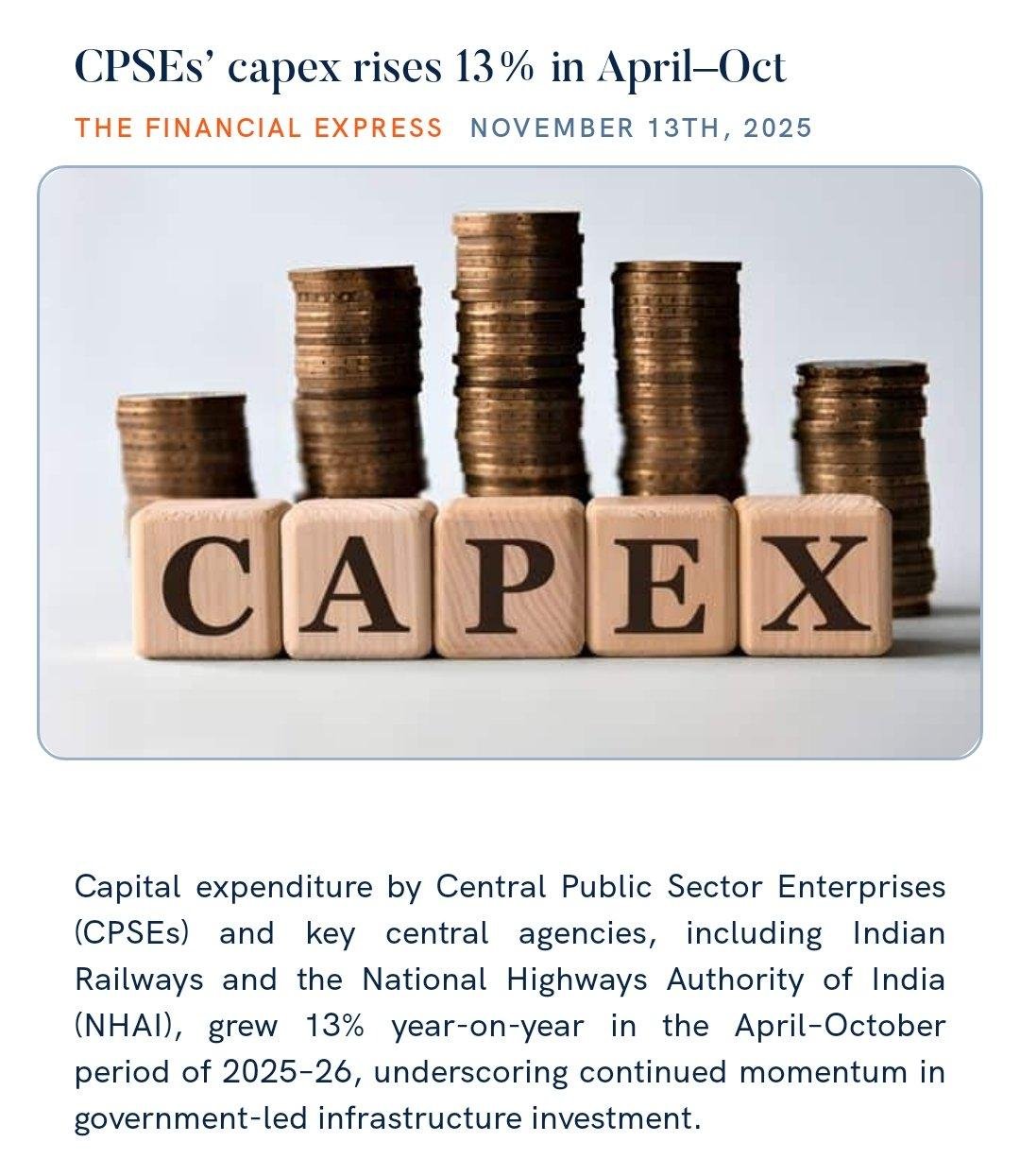
The combined capital expenditure by CPSEs and other central agencies (including Indian Railways and National Highways Authority of India) rose by 13% year-on-year in April–October 2025–26.
In this April–October period, the total capex was about ₹4.4 lakh crore, compared with about ₹3.9 lakh crore in the same period last year.
This spending accounts for 56.5% of the full-year target of ~₹7.85 lakh crore.
However, the pace of investment slowed in October: capex growth in October alone was ~6% year-on-year, with spending of ~₹58,327 crore.
Major drivers: Railways + NHAI account for ~₹4.4 lakh crore — about 56% of the total FY26 target for CPSEs & central agencies.
For FY25: These entities invested ₹7.86 lakh crore) by ~3%.
Interpretation / significance
A 13% year-on-year growth in capex suggests continuing momentum in government-led investment.
Achieving over half the full-year target within the first seven months is a positive indicator for meeting or exceeding FY26 targets.
The slowdown in October (growth only ~6%) might signal some caution: high base effects (for example, a strong September), or project execution bottlenecks.
Heavy dependence on rail & highways means any delay or slowdown in those sectors could impact overall capex execution.
Given that public investment is a key driver of growth in India, strong capex performance is supportive of broader economic momentum.
Caveats / things to watch
While the growth looks decent, the base was moderately high last year, so sustaining higher growth may be challenging.
Execution risks: large-scale spend needs timely clearances, land acquisition, supply chain etc. Any delays could slow down capex.
Sectoral concentration: With so much of the capex concentrated in rail & highways, the risk is less diversification — if those segments slow, the aggregate may suffer.
The article notes moderation in October — important to monitor whether that trend continues into the remaining months of the fiscal.
The combined capital expenditure by CPSEs and other central agencies (including Indian Railways and National Highways Authority of India) rose by 13% year-on-year in April–October 2025–26.
In this April–October period, the total capex was about ₹4.4 lakh crore, compared with about ₹3.9 lakh crore in the same period last year.
This spending accounts for 56.5% of the full-year target of ~₹7.85 lakh crore.
However, the pace of investment slowed in October: capex growth in October alone was ~6% year-on-year, with spending of ~₹58,327 crore.
Major drivers: Railways + NHAI account for ~₹4.4 lakh crore — about 56% of the total FY26 target for CPSEs & central agencies.
For FY25: These entities invested ₹7.86 lakh crore) by ~3%.
Interpretation / significance
A 13% year-on-year growth in capex suggests continuing momentum in government-led investment.
Achieving over half the full-year target within the first seven months is a positive indicator for meeting or exceeding FY26 targets.
The slowdown in October (growth only ~6%) might signal some caution: high base effects (for example, a strong September), or project execution bottlenecks.
Heavy dependence on rail & highways means any delay or slowdown in those sectors could impact overall capex execution.
Given that public investment is a key driver of growth in India, strong capex performance is supportive of broader economic momentum.
Caveats / things to watch
While the growth looks decent, the base was moderately high last year, so sustaining higher growth may be challenging.
Execution risks: large-scale spend needs timely clearances, land acquisition, supply chain etc. Any delays could slow down capex.
Sectoral concentration: With so much of the capex concentrated in rail & highways, the risk is less diversification — if those segments slow, the aggregate may suffer.
The article notes moderation in October — important to monitor whether that trend continues into the remaining months of the fiscal.
0 Reacties
0 aandelen
2K Views
0 voorbeeld

 English
 Arabic
 French
 Spanish
 Portuguese
 Deutsch
 Turkish
 Italiano
 Russian
 Romaian
 Portuguese (Brazil)
 Greek
Greek